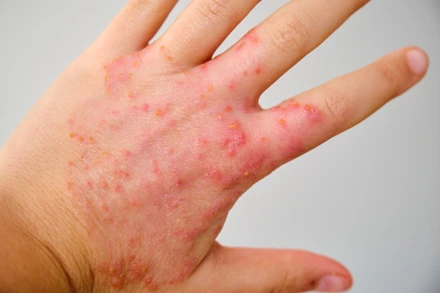
Scabies is a contagious skin condition that can cause intense itching, small red bumps, and a rash. The itching is often worse at night, which can make it difficult to sleep.
Scabies spreads mainly through close, prolonged skin-to-skin contact. It can affect anyone and is not simply a result of poor personal hygiene. Because it can spread easily between people living in the same home, treating close contacts and washing commonly used clothes and bedding can be an important part of managing an outbreak.
What is Scabies?
Scabies is caused by a tiny mite called Sarcoptes scabiei. The female mite burrows into the upper layer of the skin and lays eggs, leading to an itchy skin reaction.
The rash can appear in different areas of the body. Common sites include:
- Between the fingers
- Wrists
- Elbows
- Armpits
- Waist
- Buttocks
- Genital area
- Around the nipples
- Feet and ankles
In young children, the scalp, face, palms, and soles may also be affected.
Symptoms of Scabies
The most common symptom is severe itching, particularly at night.
Other symptoms may include:
- Small red or skin-coloured bumps
- Tiny blisters
- Thin, crooked lines or burrows on the skin
- Scratching marks
- Dry or irritated skin
- Crusting in severe cases
- Sores caused by repeated scratching
The itching may continue for some time even after the mites have been successfully treated.
What Causes Scabies?
Scabies is caused by infestation with the Sarcoptes scabiei mite.
The condition commonly spreads through:
- Prolonged skin-to-skin contact
- Close household contact
- Sharing a bed with an infected person
- Sexual contact
- Occasionally, sharing clothing, towels, or bedding
Brief contact such as a quick handshake is less likely to spread ordinary scabies.
Is Scabies Contagious?
Yes. Scabies can spread from one person to another through close contact.
If one person in a household develops scabies, other close contacts may also need evaluation or treatment, even if they have not developed itching yet.
This is important because symptoms may take several weeks to appear after the first infestation.
Types of Scabies
Ordinary Scabies
This is the most common form. It usually causes intense itching and a rash with small bumps or burrows.
Crusted Scabies
Crusted scabies is a more severe form in which large numbers of mites can be present. The skin may become thick, crusted, and scaly.
It can spread very easily and requires prompt medical treatment.
Scabies in Children
Children may develop lesions on areas that are less commonly affected in adults, including the scalp, face, palms, and soles.
Babies and young children with suspected scabies should be evaluated by a healthcare professional.
How is Scabies Diagnosed?
A doctor can often recognize scabies from the pattern of itching, rash, and burrows.
Diagnosis may involve:
- Examination of the skin
- Questions about itching and when it started
- Checking other household members
- Looking for typical burrows
- Skin scraping or other testing when the diagnosis is uncertain
Because several skin conditions can cause itching and rashes, professional diagnosis can be useful when the symptoms are unclear.
Treatment for Scabies
Scabies requires treatment that targets the mites. Treatment should also address close contacts and the household environment when appropriate.
Medical Treatment
Doctors commonly use prescription or recommended anti-scabies medicines applied to the skin or, in certain situations, oral medicines.
The exact treatment depends on age, pregnancy status, severity, other health conditions, and the type of scabies.
It is important to follow the treatment instructions carefully. Applying too little medicine or failing to treat close contacts can contribute to continued spread.
Household Measures
Along with treatment:
- Wash recently used clothes, towels, and bedding in hot water when possible
- Dry washed items thoroughly
- Items that cannot be washed can be sealed in a bag for an appropriate period
- Avoid close skin-to-skin contact until treatment has been completed as advised
- Close household contacts should seek medical advice about treatment
The main goal is to stop the mites from spreading to other people and reduce the chance of reinfestation.
Homeopathic Treatment for Scabies
At Dr. Sanjay’s Homoeopathy, homeopathic consultation for scabies focuses on the person’s skin symptoms, itching pattern, general health, and other individual complaints.
However, because scabies is caused by a contagious mite, treatment that specifically eliminates the mites is important. Homeopathic care should not delay or replace appropriate anti-scabies treatment, particularly when several household members are affected or symptoms are severe.
Homeopathic Remedies for Scabies
In homeopathic practice, different remedies may be considered according to the individual’s symptoms. Commonly discussed remedies include:
Sulphur: Traditionally considered when itching is intense, particularly when it becomes worse at night or with warmth.
Psorinum: May be considered in homeopathic practice when itching is persistent and associated with recurring skin complaints.
Crotalus Horridus: Traditionally considered in certain cases involving significant skin irritation and itching.
Rhus Toxicodendron: May be considered when itchy skin lesions are accompanied by irritation and a tendency to scratch.
Graphites: Sometimes considered when skin problems involve dryness, cracking, or oozing.
The appropriate medicine depends on the individual’s symptoms and should be selected by a qualified practitioner.
How Can You Prevent Scabies?
You can reduce the chance of spreading scabies by:
- Avoiding close skin-to-skin contact with an infected person until treatment is completed
- Washing recently used bedding and clothing
- Not sharing towels or clothing
- Getting close household contacts evaluated when appropriate
- Completing treatment exactly as advised
- Following household cleaning instructions provided by your healthcare professional
Good hygiene is helpful, but scabies is not caused simply by being unclean.
How Long Does Scabies Take to Improve?
The mites can usually be eliminated with appropriate treatment, but the itching may continue for a few weeks because the skin can remain irritated after the infestation has cleared.
If new burrows or fresh bumps continue to appear after treatment, or the itching is getting worse rather than better, another medical assessment may be needed.
When Should You See a Doctor?
Medical advice is recommended if:
- The itching is severe or persistent
- You notice burrows or a typical scabies rash
- Other people in your household are also itching
- The skin has become infected from scratching
- There are thick crusted areas on the skin
- A baby or young child may have scabies
- Symptoms continue after treatment
- You are unsure whether the rash is actually scabies
Frequently Asked Questions (FAQs)
Is scabies caused by poor hygiene?
No. Scabies is caused by a mite and can affect people regardless of their level of personal hygiene.
Is scabies contagious?
Yes. It mainly spreads through prolonged close skin-to-skin contact. Household members and other close contacts can be at risk.
Why is scabies itching worse at night?
The itching associated with scabies often becomes more noticeable at night. Warmth and reduced distractions while sleeping may also make the sensation feel stronger.
Can scabies spread to the whole family?
Yes. Close household contact can allow scabies to spread between family members. Close contacts may need evaluation and treatment even if they do not have symptoms yet.
Can scabies come back after treatment?
It can appear to return for different reasons. Persistent itching does not always mean that live mites are still present, because itching can continue after successful treatment. However, new burrows or new lesions should be assessed.
Can scabies be treated permanently?
With appropriate treatment and proper management of close contacts and household items, scabies can be cleared. Reinfection can occur if a close contact remains untreated.
Can homeopathy treat scabies?
Homeopathic consultation may focus on the individual’s symptoms and general health, but scabies requires treatment directed at eliminating the mites. Appropriate anti-scabies treatment should not be delayed.
When is scabies more serious?
Crusted scabies is a more severe form and can spread easily. Extensive crusting, severe skin changes, or signs of bacterial infection require prompt medical attention.
Why Choose Dr. Sanjay’s Homoeopathy for Scabies Treatment in Lucknow, India?
Dr. Sanjay’s Homoeopathy is a trusted clinic for Scabies Treatment in Lucknow, India. With more than 22 years of experience, Dr. Sanjay Singh, MD (Homoeopathy) provides personalized homeopathic care for people dealing with itching, recurring skin complaints, rashes, and other related symptoms. Each case is assessed according to the pattern of itching, appearance of the skin, duration of symptoms, and overall health. As an experienced homeopathic doctor in Lucknow, Dr. Sanjay Singh provides patient-focused consultation in a comfortable environment. Patients from Lucknow and other parts of India choose Dr. Sanjay’s Homoeopathy for experienced care and personalized attention.