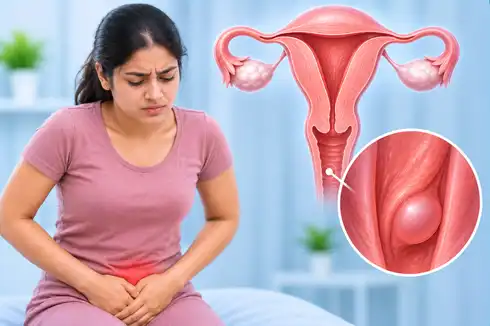
Quick answer: A vaginal cyst is a closed, fluid-filled sac or lump that forms in or just inside the wall of the vagina. Most are small, painless, and harmless, and many need no treatment. The most common types include Bartholin’s gland cysts, Gartner’s duct cysts, and inclusion cysts. A cyst that becomes painful, swollen, or infected (an abscess), or a lump that is growing, hard, or bleeding, should be checked by a doctor.
Introduction
Vaginal cysts are small lumps or sacs that develop on or under the lining of the vagina. They are usually filled with fluid, mucus, or other material and range from the size of a pea to the size of a plum or larger, although most are small.
Vaginal cysts are not contagious and are not caused by cancer in most cases. They are common, and many women have one without knowing, finding it only during a routine pelvic examination.
Most vaginal cysts cause no symptoms and need only observation. Some can become uncomfortable, cause pain during sex or when inserting a tampon, or become infected. Understanding the type of cyst and recognising the signs that need medical attention helps you decide what to do and avoid unnecessary worry.
What are Vaginal Cysts?
A vaginal cyst is a closed pocket of tissue that fills with fluid, mucus, pus, or air. It can form when a gland or duct becomes blocked, when surface tissue is trapped beneath the skin during healing, or from leftover tissue from the development of the female genital tract before birth.
Vaginal cysts can form anywhere inside the vagina or near its opening. Some, such as Bartholin’s cysts, are located at the vaginal opening (in the vulva) and are often grouped with vaginal cysts because they are felt at the entrance of the vagina.
Vaginal cysts may resemble other conditions, such as a pelvic organ prolapse (a bulge from a weakened pelvic floor), a urethral diverticulum, fibroids, abscesses, or, rarely, growths that may be cancerous. A healthcare professional can help distinguish between these, especially when the lump is hard, growing, painful, or bleeding.
What are the Symptoms of Vaginal Cysts?
Many vaginal cysts cause no symptoms at all.
Common symptoms, when present, include:
- A smooth lump or bulge: A soft, round swelling that can be felt in or near the vagina, often painless.
- Feeling of pressure or fullness: A heaviness or sense of something in the vagina.
- Discomfort during sex: Pain or discomfort during intercourse.
- Difficulty inserting a tampon or menstrual cup: Or discomfort while using one.
- Discomfort when sitting, walking, or exercising: Especially with larger cysts near the vaginal opening.
- Difficulty during pelvic examination: A cyst may be noticed during a routine exam.
- Urinary symptoms: A large cyst may press on the urethra and cause difficulty passing urine or a frequent urge to urinate.
If the cyst becomes infected or forms an abscess, symptoms may include:
- Pain and tenderness: Increasing pain, redness, and warmth around the lump.
- Swelling: A rapidly enlarging tender swelling.
- Pus or discharge: Drainage from the cyst.
- Fever and feeling unwell: In more significant infections.
Increasing pain, fever, rapid swelling, bleeding, or a hard or fixed lump needs prompt medical assessment.
What are the Causes of Vaginal Cysts?
Vaginal cysts form for different reasons depending on their type.
- Blocked Glands (Bartholin’s and Skene’s Cysts): The Bartholin’s glands, on each side of the vaginal opening, produce lubricating fluid. If a duct becomes blocked, fluid collects and forms a cyst. Skene’s glands near the urethral opening can be affected in a similar way.
- Injury or Trauma to the Vaginal Wall: Childbirth, episiotomy, tears, surgery, or other injury can trap small pieces of surface tissue under the skin, forming an inclusion cyst.
- Remnants of Embryonic Structures: Leftover tissue from structures that existed before birth can later form cysts. Gartner’s duct cysts, usually found on the side wall of the vagina, and Müllerian cysts develop this way.
- Infection: Bacterial infection, including from sexually transmitted infections and other bacteria, can block glands and lead to infected cysts or abscesses.
- Endometriosis-Related Cysts: Rarely, endometriosis tissue can form cyst-like lesions in the vaginal wall.
- Hormonal and Other Factors: Changes in hormones and past vaginal procedures may contribute to cyst development in some women.
Identifying the type of cyst helps guide whether treatment is needed and which treatment is best.
Types of Vaginal Cysts
- Vaginal Inclusion Cysts: The most common type. They form when skin cells become trapped beneath the vaginal lining, most often after childbirth, an episiotomy, or surgery. They are usually small and found in the lower part of the vagina.
- Bartholin’s Gland Cysts: Develop at the vaginal opening when a Bartholin’s gland duct is blocked. They can become infected, forming a painful Bartholin’s abscess.
- Gartner’s Duct Cysts: Occur along the side wall of the vagina from remnants of an embryonic duct. They are usually small and symptom-free.
- Müllerian Cysts: Form from remnants of the Müllerian ducts, often in the upper vagina, and contain mucus.
- Skene’s Duct Cysts: Located next to the urethral opening, and may affect the urinary stream if large.
- Endometriotic Cysts: Uncommon cyst-like lesions caused by endometriosis tissue.
Correct identification of the type of cyst guides treatment and monitoring.
Risk Factors for Vaginal Cysts
- Previous vaginal childbirth, especially with tears or an episiotomy.
- Previous gynaecological or vaginal surgery.
- Injury or trauma to the vaginal or genital area.
- Being of reproductive age (Bartholin’s cysts are most common between 20 and 30 years of age).
- Sexually transmitted or other genital infections.
- Blocked glands or ducts.
- A history of previous cysts.
- Endometriosis.
Not everyone with these risk factors develops a cyst. Many cysts have no identifiable cause.
Diagnosis of Vaginal Cysts
Vaginal cysts are usually found during a pelvic examination.
- Medical History: The doctor asks about symptoms, how long the lump has been present, any change in size, pain, discharge, previous childbirth, surgery, infections, and sexual history.
- Pelvic Examination: The doctor examines the vulva, vaginal walls, urethra, and nearby structures to find the location, size, and nature of the lump.
- Imaging: Ultrasound or MRI may be used to check the size and depth of the cyst, and to tell it apart from other conditions such as a urethral diverticulum or pelvic mass.
- Laboratory Tests: If infection is suspected, swabs of the cervix, vagina, or cyst fluid may be tested for bacteria, including sexually transmitted organisms.
- Biopsy: A small sample may be taken, especially if the lump looks unusual, is hard, is growing, or if a Bartholin’s gland mass appears in a woman over 40 or after menopause, to rule out other conditions.
- Specialist Assessment: A gynaecologist usually evaluates persistent, symptomatic, or unusual cysts.
Treatment for Vaginal Cysts
Treatment depends on the type of cyst, its size, symptoms, and whether it is infected.
- Observation: Small cysts that cause no symptoms often need no treatment and can be watched during routine check-ups.
- Warm Sitz Baths: Sitting in a few inches of warm water for 10 to 15 minutes, several times a day, can ease discomfort and may help a Bartholin’s cyst to drain on its own.
- Pain Relief: Over-the-counter pain relievers may help with discomfort when used as advised by a doctor or pharmacist.
- Antibiotics: Antibiotics are prescribed if there is an infection or an abscess, or if a sexually transmitted infection is found. They are not needed for a simple, uninfected cyst.
- Drainage: A doctor may drain a painful or infected cyst. For Bartholin’s cysts, a small tube (Word catheter) may be left in place for a few weeks so that the cyst can drain and the opening stays patent.
- Marsupialization: A minor procedure for recurrent Bartholin’s cysts, in which the edges of the cyst are stitched open to form a permanent drainage pouch.
- Surgical Removal: Complete removal of the cyst (excision) may be advised for large or persistent cysts, those that keep coming back, or those causing symptoms, and is done by a gynaecologist.
- Treating Underlying Causes: Infections and conditions such as endometriosis should be treated appropriately.
- Avoid Self-Treatment: Do not squeeze, prick, or try to drain a cyst yourself, as this can cause infection, bleeding, and scarring.
- Follow-Up: Recurrence is possible, and changing or persistent cysts should be reassessed.
Homeopathic Consultation for Vaginal Cysts
Discovering a lump in the vaginal area can be worrying and uncomfortable to talk about. Many women look for gentle, private, and personalised support for recurring discomfort, general wellbeing, and menstrual or hormonal concerns while following appropriate medical evaluation.
At Dr. Sanjay’s Homoeopathy, consultations with Dr. Sanjay Singh, MD (Homoeopathy), include a confidential, unhurried discussion of the symptom pattern, history of cysts, gynaecological and menstrual history, previous infections and reports, current medicines, and lifestyle. The aim is to understand the person as a whole and offer individualized, supportive care alongside appropriate medical and gynaecological assessment. Women with painful, infected, or rapidly growing lumps are advised to seek prompt medical evaluation, and are never asked to stop prescribed medicines or skip recommended tests or procedures.
Remedies Traditionally Used in Homeopathic Treatment of Vaginal Cysts
In traditional homeopathic practice, some remedies have been associated with particular patterns of cysts, swellings, and recurring glandular complaints. These include:
- Thuja occidentalis: Traditionally associated with recurring growths and cyst-like swellings.
- Silicea: Traditionally described for slow-healing, recurrent glandular swellings and suppuration.
- Apis mellifica: Traditionally associated with stinging, burning, puffy swellings.
- Calcarea carbonica: Traditionally associated with recurring glandular complaints in sensitive constitutions.
- Hepar sulphuris calcareum: Traditionally described for painful, sensitive swellings with a tendency to form pus.
These descriptions reflect traditional homeopathic use. They do not replace medical evaluation of a vaginal lump, drainage of an abscess, antibiotics for infection, or surgery when recommended. Remedies are chosen individually after consultation.
Lifestyle Tips for Managing Vaginal Cysts
- Keep the Area Clean and Dry: Wash gently with warm water and mild, unperfumed soap on the outside only, and dry thoroughly.
- Avoid Douching: Douching can disturb natural vaginal bacteria and does not prevent cysts.
- Wear Breathable Underwear: Cotton underwear and loose clothing reduce moisture and irritation.
- Practise Safe Sex: Use condoms and have regular testing to lower the risk of infections that can block glands.
- Use Warm Sitz Baths: Regular warm sitz baths can help ease discomfort from a Bartholin’s cyst.
- Do Not Squeeze or Puncture Cysts: This can cause infection and make the problem worse.
- Avoid Irritants: Avoid perfumed products, harsh wipes, and tight clothing in the genital area.
- Go for Routine Gynaecological Check-ups: Regular check-ups help find cysts early and track any changes.
- Look After Recovery After Childbirth or Surgery: Follow the doctor’s advice on wound care, hygiene, and follow-up after procedures involving the vagina or perineum.
When to See a Doctor for Vaginal Cysts
Seek medical advice if you notice a new lump or bulge in or near the vagina, or if a known cyst changes.
Arrange prompt assessment if you experience:
- A lump that is growing, painful, or tender.
- Redness, heat, or swelling around the lump.
- Pus or foul-smelling discharge.
- Fever or feeling unwell with a vaginal swelling.
- Pain during sex or when inserting a tampon.
- Difficulty passing urine, or a changed urine stream.
- A hard, fixed, or irregular lump.
- Unusual vaginal bleeding.
- A new vaginal or vulval lump after menopause or after the age of 40.
- A cyst that keeps coming back.
Seek urgent medical care for severe pain, rapidly spreading redness or swelling, high fever, or inability to pass urine. These may signal an abscess or serious infection.
Frequently Asked Questions About Vaginal Cysts
What is a vaginal cyst?
A vaginal cyst is a closed, fluid-filled sac or lump that forms in or just inside the vaginal wall. Most are small, painless, and harmless.
What causes vaginal cysts?
Common causes include blocked glands, trapped skin tissue after childbirth or surgery, leftover embryonic tissue, and infection.
Are vaginal cysts dangerous?
Most vaginal cysts are benign and not dangerous. However, an infected cyst can form an abscess, and any lump that is hard, growing, bleeding, or appearing after menopause should be checked by a doctor.
Are vaginal cysts contagious?
No. Vaginal cysts are not contagious, although a sexually transmitted infection can sometimes contribute to an infected gland.
What is the difference between a vaginal cyst and a Bartholin’s cyst?
A Bartholin’s cyst forms at the vaginal opening when a Bartholin’s gland duct is blocked. Other vaginal cysts form within the vaginal wall. Both can be felt as a lump near the vagina.
Do vaginal cysts go away on their own?
Small cysts often stay the same or may shrink without treatment. Some Bartholin’s cysts drain on their own, especially with warm sitz baths. Others need treatment.
Can I pop or drain a vaginal cyst myself?
No. Squeezing or puncturing a cyst can cause infection, bleeding, and scarring. See a doctor if a cyst is painful or troublesome.
Can vaginal cysts affect pregnancy or childbirth?
Small cysts usually do not. A large cyst near the vaginal opening or birth canal may need to be assessed by the obstetrician before delivery.
Do vaginal cysts come back?
Some cysts, particularly Bartholin’s cysts, can recur. Procedures such as marsupialization or removal reduce the chance.
Can homeopathy be taken along with regular care for vaginal cysts?
Many women choose a homeopathic consultation for overall comfort and wellbeing while continuing medical assessment and any treatment advised. It is important to inform every doctor about all medicines being taken, and never to ignore a painful, infected, or growing lump or stop prescribed treatment without medical advice.
Why choose Dr. Sanjay’s Homoeopathy for vaginal cyst treatment in Lucknow, India?
Dr. Sanjay’s Homoeopathy is a trusted Homeopathy Centre for Vaginal Cyst Treatment in Lucknow, India. With more than 22 years of experience, Dr. Sanjay Singh, MD (Homoeopathy) follows an individualized consultation approach that considers the patient’s symptoms, medical history, lifestyle, and previous treatment. People experiencing a small painless lump, localized swelling, tenderness, pelvic pressure, or discomfort while walking or sitting can discuss their concerns and learn about available care options in a patient-focused environment. Identifying the specific type of cyst and any underlying gland blockages or infections remains an important part of effective care, and patients should continue necessary gynecological evaluation and medical treatment as advised by their healthcare professional. Patients from across the world trust Dr. Sanjay’s Homoeopathy for Vaginal Cyst Treatment in Lucknow, India.